Prim's Algorithm Time Complexity Adjacency Matrix
Prim's Algorithm Time Complexity Adjacency Matrix. So, worst case time complexity will be o (v 2 ), where v is the number of vertices. As discussed in the previous post, in prim’s algorithm, two sets are maintained, one set contains list of vertices already included in mst, other set contains vertices not yet included.
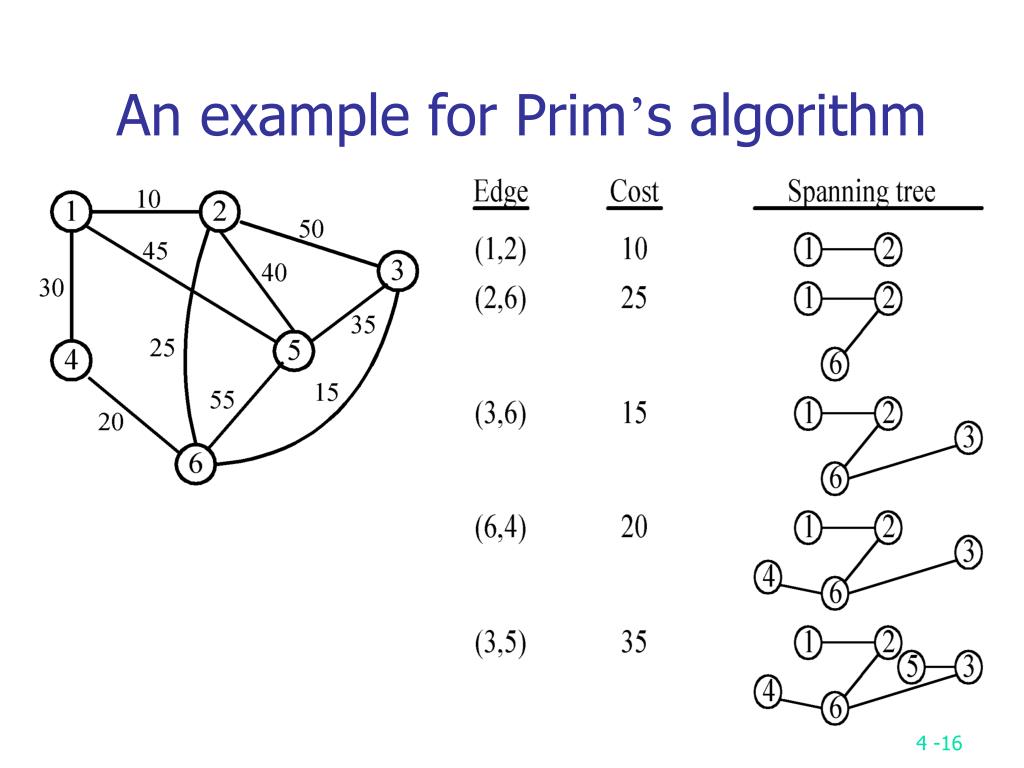
In this post, o (elogv) algorithm for adjacency list representation is discussed. This way, we only ever check distance to find the next target, and since we do this v times and there are v members of distance, our complexity is o (v^2). O(vlogv) + o(elogv) = o((e+v)logv) = o(elogv)
Of Edges, And V Is The No.
If adjacency list is used to represent the graph, then using breadth first search, all the vertices can be traversed in o(v + e) time. The problem is that they want to efficiently transfer a piece of information to anyone and everyone who may be listening. So, worst case time complexity will be o (v2), where v is the number of vertices.
Use Of Adjacency Matrix Provides The Simple Implementation Of The Prim's Algorithm.
In prim’s algorithm, we need to search for the edge with a minimum for that vertex. We have discussed prim’s algorithm and its implementation for adjacency matrix representation of graphs. Now, let's see the implementation of prim's algorithm.
Autrement Dit, Le Sommet Possédant La Plus Faible Valeur Dans Le Tableau Cout[.] 2 14.
There is this prim's algorithm i am studying, the time complexity of which is $o(n^2)$ (in the adjacency matrix). Initially the spanning tree is empty. Use of adjacency matrix provides the simple implementation of the prim’s algorithm.
The For Loop At Line 8 Is Executing Total 2E Times As Length Of Each Adjacency Lists Is 2E For An Undirected Graph.
The time complexity of the prim's algorithm is o(e logv) or o(v logv), where e is the no. It can be improved further by using the implementation of heap to find the minimum weight edges in the inner loop of the algorithm. I am using this as a reference.
Use Of Adjacency Matrix Provides The Simple Implementation Of The Prim’s Algorithm.
V = {1,2.,n} u = {1} t = null while v != u: In prim’s algorithm, we need to search for the edge with a minimum for that vertex. Time complexity adjacency list representation is o(e log v).


Komentar
Posting Komentar